Some places are just not the right spot for sunflowers. So what should you plant — and does the science actually back it up?
Almost everyone who wants to help pollinators eventually asks the same question: what should I plant? The internet offers no shortage of lists. But nearly all of them are generic, and almost none of them are backed by data — and very few account for the fact that what draws bees in California may be irrelevant in Minnesota or Georgia. We want to change that. And we need your help to do it.
Why plant lists aren't enough — yet
The honest answer is that we don't fully know which plants are the best pollinator plants in your region. Not because no one has thought to ask, but because answering it properly requires something that has been missing: systematic, place-specific observation data at a large scale.
What we do know is that pollinators are not evenly distributed across plant species. Some plants are magnets. Others — even plants that look like they should be attractive — get almost no visits. And which plants fall into which category can vary significantly by region, by bee community, and by what else is blooming nearby. A plant list that works in the mid-Atlantic may be misleading in the Southwest.
We aim to build region-specific, data-backed plant lists over time. We're already compiling observations. Here's how you can contribute.
How to submit a pollinator plant observation
This is careful, quiet, rewarding work. You don't need special equipment — just a plant you can identify, a watch, and your full attention for five minutes.
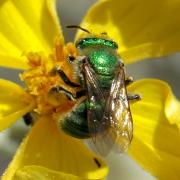
Agapostemon sp. — Photo: Hartmut Wisch |
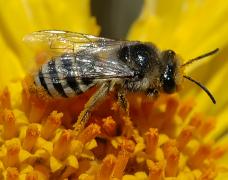
Colletes female — Photo: Hartmut Wisch |
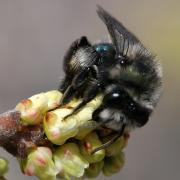
Andrena cerasifolia female — Photo: Hartmut Wisch |
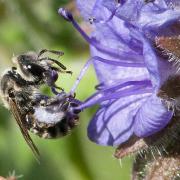
Dufourea female — Photo: Hartmut Wisch |
The bees above — an Agapostemon, a Colletes, an Andrena, and a Dufourea — are four of the hundreds of native bee species visiting gardens across North America. All four are ground-nesters. None of them is a honeybee. This is the diversity we're trying to understand and protect.
- Have an accurate identification of the plant you are observing. This is the foundation of the data. If you're not certain of the species, narrow it down as far as you can — genus is better than nothing, but species is best. If you grow it yourself from labeled seed or a tagged nursery plant, you're in good shape.
- Observe that plant for at least five minutes. Stand or sit where you have a clear view of the flowers. Try to observe during a time of day when bees are likely to be active — mid-morning through mid-afternoon on a warm, calm day is usually best.
- Count every single pollinator that visits. Every bee, butterfly, wasp, fly, and beetle that touches the flowers. Don't try to identify them as you go — just count. You can note general categories if it's easy (bees vs. butterflies), but a raw count is what the science needs.
- Report your observation on our website as a stationary count. Include the plant species, your location, the date and time, how long you observed, and your total count. The more details you can provide, the more useful your observation becomes.
Any flowering plant counts — not just sunflowers. If you want to help us understand which plants in your region attract the most pollinators, observe whatever is blooming in your yard, garden, or neighborhood. Coneflowers, goldenrod, lavender, phacelia, native asters, fruit tree blossoms — all of it is useful data. The more plant species we have observations for, the better the regional lists we can build.
Register to submit a stationary count →
What we will do with your data
We will compile observations by state and region, and over time use them to identify which plants are consistently drawing the most pollinator visits — not based on anyone's opinion or tradition, but based on what you actually watched happen. If we can determine which plants are genuine bee magnets in each part of the country, we can start giving gardeners, land managers, restoration ecologists, and urban planners real guidance about what to plant where.
That's the goal: not another generic plant list, but something more useful — a living, regionally specific resource built from thousands of careful five-minute observations made by people like you.
The bees will do the rest.
Want to go further? While you're observing pollinator plants, you can also improve the habitat around them. See our Great Pollinator Habitat Challenge for a step-by-step guide — or check your garden for pesticides that may be undercutting your efforts without your knowing it.